
The California fridge won't cool: diagnosis and fixes
With the control unit's diagnostics, a multimeter and an ear for the noises, you can almost always tell why the compressor fridge isn't cooling.
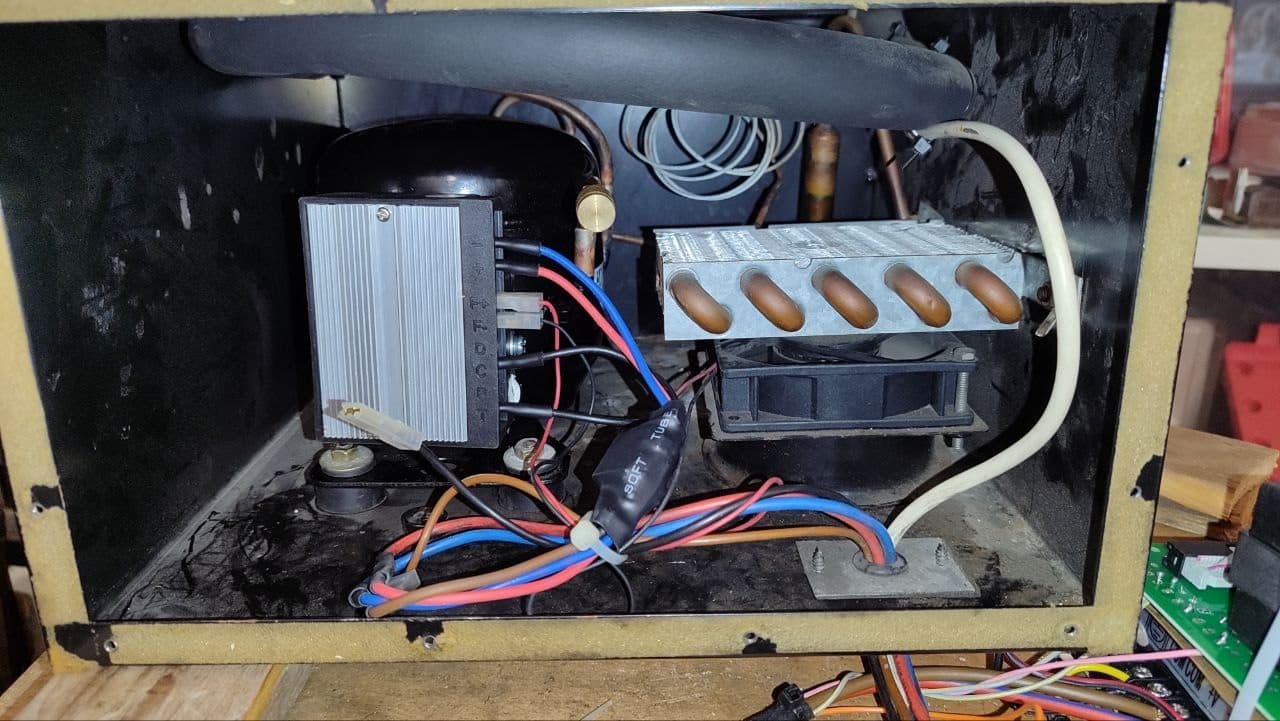
With the control unit's diagnostics, a multimeter and a little attention to the noises, you can almost always tell why the California's compressor fridge isn't cooling, and whether you can repair it yourself or need a refrigeration technician.
California fridges are now almost thirty years old, and the faults are always the same. This guide takes you step by step from the symptom to the cause, and gives the fix for each cause.
Guide by xGiacomo, written for the T4UM community and adapted for t4um.it. Thanks to xGiacomo for the experience and the time he has shared with everyone.
Before you start
This guide assumes you have already read the California owner's manual and tried the tips it contains. So before going further, rule out the most obvious causes:
- flat batteries;
- correct switch-on procedure: press the two buttons at the same time;
- blown fridge fuse: it is behind the driver's seat.
Step one: the control unit diagnostics
Run the Westfalia control unit diagnostics by following this video (in Italian): control unit diagnostics.
During the diagnostics write down two values, which you will need later:
- the fridge internal temperature read by the control unit;
- the current draw with the fridge on.
Step two: listen to the motor
Switch the fridge on: the fridge symbol appears on the display, steady or flashing. For a couple of minutes listen carefully to the lower part of the fridge, where the motor is, and work out which case you are in:
| Case | What you hear |
|---|---|
| 1 | No noise: the motor does not run, everything is dead |
| 2 | The motor runs, but the fridge does not cool, or cools poorly |
| 3 | The motor tries to start, you hear a high-pitched whistle and it stops; after a few minutes it tries again, endlessly |
The diagram sums up the whole path, from symptom to cause:
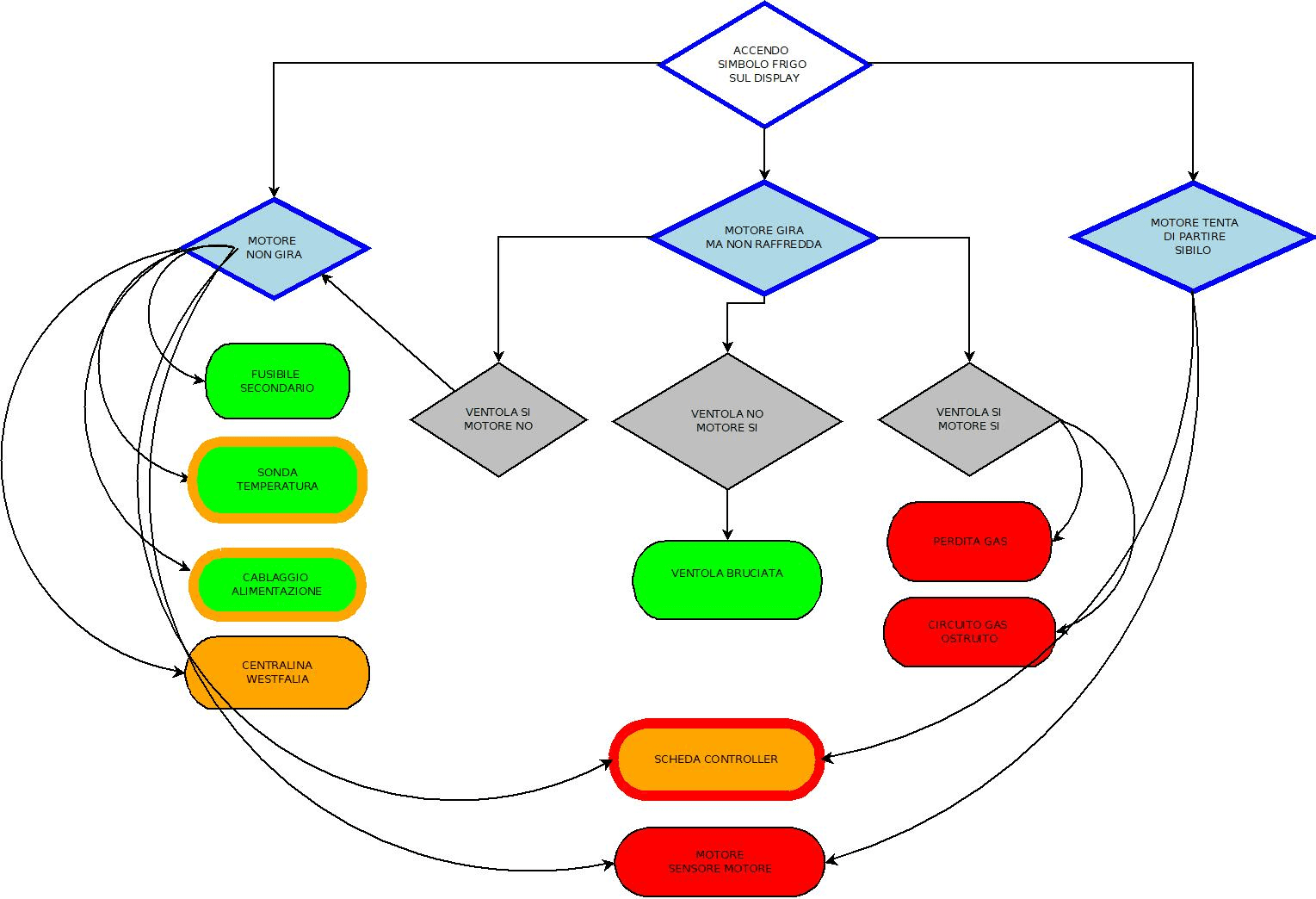
The colours of the diagnoses show how hard the fix is:
| Colour | Meaning |
|---|---|
| Green | Easy fix |
| Orange | There may be complications |
| Red | You need a refrigeration technician, or a replacement fridge |
How to get to the fridge motor
In case 1 and case 2 you will have to open the motor compartment. Here is how:
- move the bench bed so you can reach the small wooden panel at the bottom;
- remove the two grey screw covers, undo the screws and take off the panel;
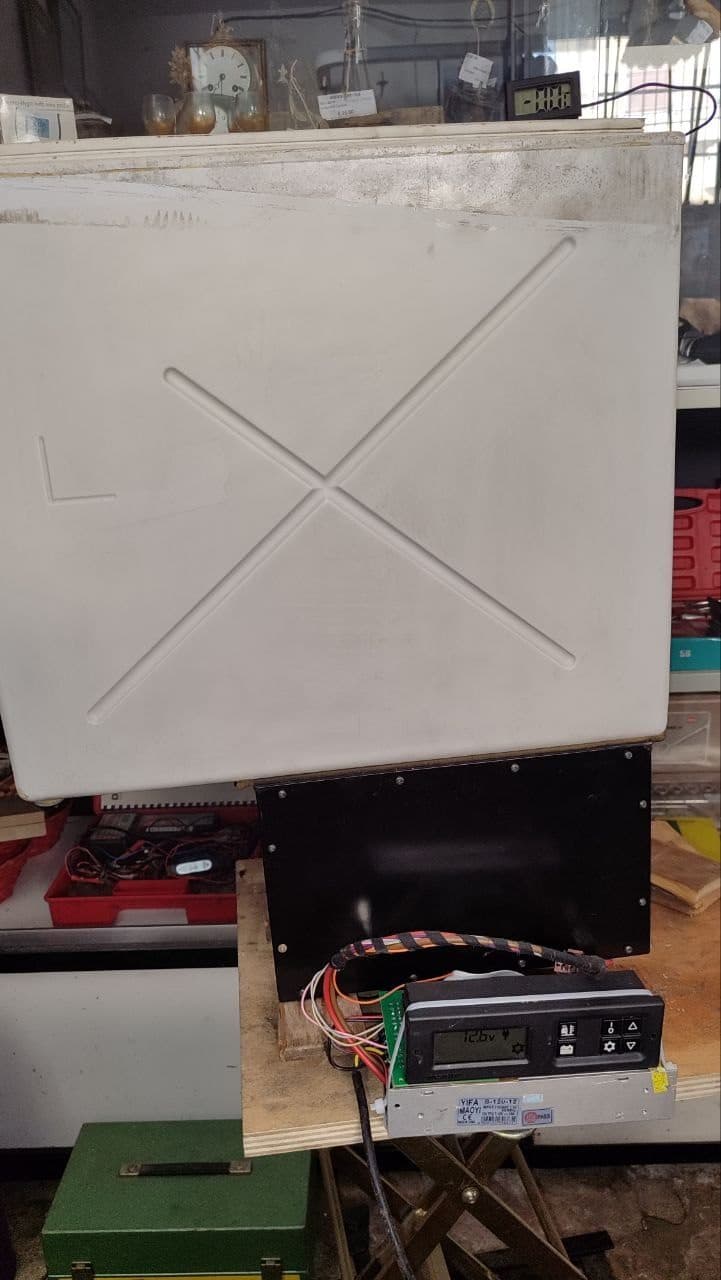
- undo the 12 screws of the black metal motor cover and open it.
Inside the cover is the motor controller board, with the fuse (40 A, 15 A on some fridges) and the terminals you need for the measurements.
Case 1: the motor doesn't run
Go through the checks in this order, stopping at the first one that finds the fault.
- Check the temperature read by the control unit. The value you noted during the diagnostics should be sensible and close to the real temperature inside the fridge. If the sensor is faulty and reads lower than the set temperature, the fridge never starts. → Diagnosis: broken temperature sensor.
- Check the board fuse (40 A, sometimes 15 A). Open the motor compartment, replace the fuse on the controller board and try switching on again. If the fuse or fuse holder is visibly damaged, the controller needs repairing. → Diagnosis: electrical problems on the motor driver.
- Measure the power supply. With the multimeter on DC volts, put the black probe on the «−» terminal, where the thick blue wire arrives, and the red one on the «+» terminal, where the thick red wire arrives. You should read the battery voltage, above 12.0 V. → If it is not there: Diagnosis: wiring or power supply problems.
- Measure the command from the control unit. Leave the black probe on «−» and move the red one to terminal «T», where the brown wire is. You should read 0 V with the fridge symbol off and 12 V with the symbol on.
- Retest with a jumper. Remove the fridge fuse for safety, disconnect the brown wire from «T» and connect «T» and «C» with a short piece of wire and some insulating tape. Put the fuse back. → If the fridge starts: Diagnosis: Westfalia control unit broken or a problem with its wiring. → If power reaches «+» and «−» but the fridge shows no sign of life even with the jumper: Diagnosis: motor or motor controller board broken.
Case 2: the motor runs but the fridge does not cool
Start from the current draw you noted during the diagnostics:
| Current draw | What it probably means |
|---|---|
| Below 1 A | Only the small fan runs, the compressor does not |
| 2-3 A | There is no gas in the system |
Then open the motor compartment and check by hand what is really running:
- The compressor doesn't run (only the fan does): follow the checks for case 1.
- The fan does not run. It is the one that, through the ducting, pushes air over the heat exchanger. → Diagnosis: broken fan.
- Compressor and fan both run, but the fridge plate doesn't cool, or cools poorly. → With a draw below 4 A: Diagnosis: no gas, leak in the system. → With a draw above 4 A: Diagnosis: clogged filter or capillary tube in the circuit.
Case 3: the motor tries to start and whistles
The problem is in the controller board or, more often, in a sensor inside the compressor that no longer reads the signal properly. The board misreads the data, believes the motor is turning backwards and stops it at start-up. On fridges close to thirty years old this is a very common fault, and the symptom leaves no doubt.
→ Diagnosis: motor Hall sensor or its electronics.
The fixes, diagnosis by diagnosis
| Diagnosis | Fix |
|---|---|
| Broken temperature sensor | The sensor sits in a white plastic cap on the right side of the cooling plate. Open or break the cap, remove the sensor and replace it with a 500 Ω NTC thermistor (470 Ω works too). Simple job, within reach of any electrician |
| Secondary fuse or motor driver problems | Replace the controller board fuse (40 A or 15 A, depending on the fridge). If the fuse holder is damaged it must be repaired. Simple job, within reach of any electrician |
| Fridge wiring or power supply | Have the continuity of the power cables checked. The problem is often the earth, connected to a faston block behind the fuse cover |
| Westfalia control unit broken or its wiring | xGiacomo is the only person making a clone of the control unit: write to him at xgiacomo@gmail.com |
| Broken fan | Replace it with an equivalent 90 mm one. The job is not easy, because there is very little room to reach the fixing screws |
| No gas, leak in the system | Don't have the gas recharged without first finding the leak: it would be like inflating a punctured tyre. The amount of gas must be exact, and even a few grams too many stop everything |
| Broken motor controller board | Hard to find and expensive. Replacing it is easy, but it does not always fix the problem and often does not last: you risk spending a lot and ending up back where you started |
| Broken motor or Hall sensor | Remove the fridge and have a refrigeration technician replace the motor and control electronics, or replace the fridge |
| Clogged filter or capillary tube | Remove the fridge and have a refrigeration technician replace the motor, control electronics, filter and capillary tube, or replace the fridge |
New or reconditioned fridge?
When the fault involves the motor, controller or gas circuit, there are two routes. In both cases you need a camper converter. They almost certainly will not know how to reconnect the fridge to the Westfalia control unit, and will fit an external thermostat.
| New fridge | Reconditioning | |
|---|---|---|
| What is done | Complete replacement of the fridge | Replacement of motor, filter, capillary tube and electronics |
| Cost | High | Much lower than a new fridge |
| Efficiency | Lower in the hot months: it does not use the original ducting and sheds heat more slowly | Higher, because it makes use of the original ducting |
| Other advantages | A new, white, good-looking fridge, with the seller's warranty | — |